Are you worried about your generator’s capacity? If your generator’s capacity doesn’t match your business needs, it can easily lead to production stoppages, extra costs, and significant losses for you. Selecting the correct generator size is essential for ensuring reliable power, avoiding equipment failures, and reducing operating costs.
Next, I will give you a detailed introduction to the matters that need to be considered when selecting a generator.
Why Generator Capacity Selection Matters
Undersized Generator Capacity May Lead To
- Frequent tripping
- Voltage drops
- Equipment failing to start
Oversized Generator Capacity May Lead To
- Increased purchase costs
- Higher fuel consumption
- Wet stacking
What Information Should You Gather Before Determining Generator Capacity?
- Total Load: The first thing to do when sizing a generator is to take stock of the load from all your equipment, as well as how long continuous power is needed. Some equipment produces surge currents when starting up, and if the sizing isn’t suitable, starting this equipment can cause the generator to shut down. You should also factor in reserve power to ensure safety.
- Voltage: The generator’s output voltage must match your equipment’s voltage, otherwise the equipment won’t run properly. Common voltages include 380V/400V and 220V/230V. Voltage standards vary by region, so please confirm the voltage standard for your region before selecting a generator.
- Frequency: Generator frequency is mainly 50Hz or 60Hz. 50Hz is commonly used in Southeast Asia, Europe, the Middle East, and Africa, while 60Hz is commonly used in the US, Canada, and parts of South America. Frequency affects the generator’s rotational speed and even the safety of your electrical equipment.
- Single-Phase or Three-Phase: You need to confirm whether the power at your site is single-phase or three-phase. Single-phase generators are better suited to light loads such as homes and small offices, while three-phase generators are better suited to large-scale projects.
- Starting Current: Many industrial devices — such as motors, water pumps, elevators, and compressors — produce a surge current the instant they start up, so you need to factor this surge current into your load calculations. Please carefully inventory all equipment in your project that contains a motor, as these will cause larger surge currents.
- Ambient Temperature: The temperature of the installation environment directly affects the genset’s performance.If the ambient temperature is high, such as in deserts or tropical regions, it is recommended to increase the radiator size, maintain good ventilation, clean the radiator regularly, and avoid running at full load.
- Altitude: As altitude increases, a diesel engine’s combustion efficiency decreases, and the overall power generation efficiency of the genset drops as well. For high-altitude areas such as mines and mountainous regions, altitude is a particularly important parameter for you to consider.
Steps to Determine Generator Set Capacity
- Calculate the Total Load: First, determine the running load of all equipment in your project.
- Calculate the Starting Load: Equipment produces a surge current when starting up, so you also need to account for transient peaks.
- Determine the Required kVA: The power factor in the generator industry is typically set at 0.8. The formula is kW = kVA × Power Factor (PF), and to convert kW to kVA, use kVA = kW ÷ Power Factor (PF).
- Choose Prime or Standby Power: Prime power ratings are typically 10%–20% lower than standby power ratings. If you’ll be using the generator frequently, the prime power rating is the parameter you should focus on most.
- Reserve Power: On top of your total load, reserve an additional 20%–30% of power to ensure your equipment and the genset run safely and to extend their service life.
Recommended Generator Capacity by Application
For Commercial Buildings
Different businesses have different power needs. You can find your commercial building’s total load from your electricity bill — the data is usually in kWh — and you just need to divide the total running time by the kWh figure to estimate the approximate power draw.
For Manufacturing Plants
Please accurately inventory the power of all your equipment, paying special attention to equipment that contains a motor, such as compressors and water pumps, since these produce larger surge currents on startup — meaning you’ll need more power. Power needs vary by factory, but typically range from 300kVA to 2500kVA.
For Hospitals
You can determine your total equipment load based on the system’s peak power usage, or calculate it from your billing system’s history. Please work with a professional to calculate the correct total load and select an appropriate generator to ensure your medical equipment runs smoothly. Hospitals typically require a load of 500kVA to 3000kVA.
For Data Centers
A data center’s power scale depends on its specific circumstances — different scales require different power levels. However, when powering a data center, you must always leave a safety margin, as many systems’ estimated energy consumption is 10%-20% lower than actual consumption. Data centers typically require power of 1000kVA or more.
For Construction Sites
First, you need to list all the tools used at your construction site and record their power ratings from the user manuals, which are usually shown in kW or kWh. Some equipment has surge current on startup, so be sure to leave enough power headroom to prevent equipment shutdowns. Construction site power needs are typically around 100kVA.
The table below is a power reference for each industry:
| Application | Typical Generator Capacity |
| Small retail store | 20-60kVA |
| Office building | 60-200kVA |
| Hotel | 200-800kVA |
| Factory | 300-2500kVA |
| Hospital | 500-3000kVA |
| Data center | 1000kVA+ |
| Construction site | 100kVA |
| Mining site | 1000kVA+ |
This table is for reference only — for your actual project, please conduct a load test.
Final thought
If you’re looking for the right generator set for your project and would like help selecting one based on your load requirements, the UsuperPower team is here to provide you with a reliable power solution tailored to your project. Our commercial generators and industrial generators cover essentially all the needs of the industry.
FAQ
What’s the difference between running power and starting power?
Running power refers to the electrical power your equipment needs during normal operation, while starting power refers to the higher power your equipment needs the moment it first starts up.
How often should a standby generator set undergo a load test?
You should conduct a load test at least once a year to confirm the equipment’s load capacity under real conditions — not just test whether it starts normally.
Should you choose an open-frame or a soundproof enclosed generator set?
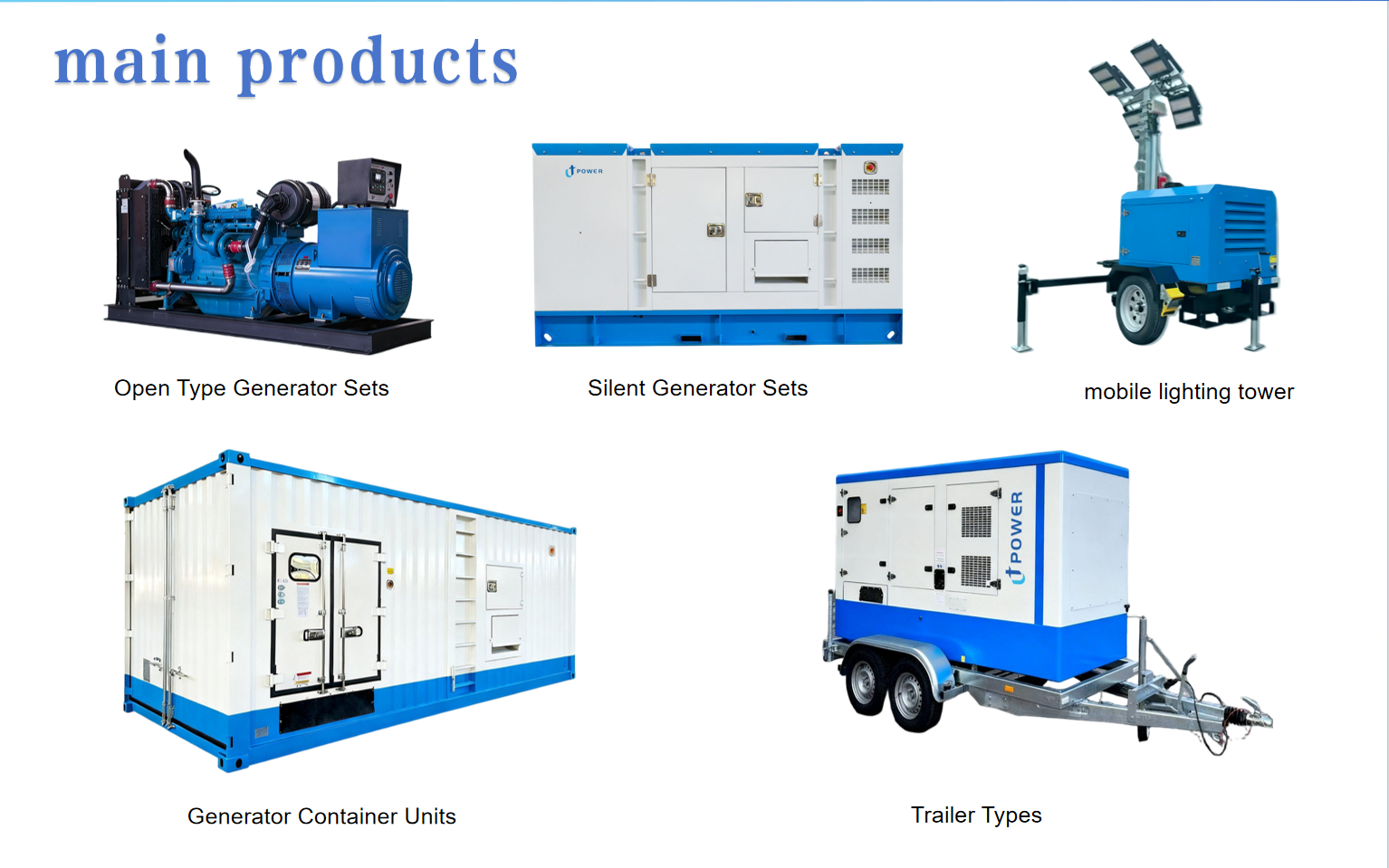
It depends on your site conditions. If your project site is far from office and residential areas, you can choose an open-frame generator; if it’s close, choose a soundproof enclosed generator set, which is also better suited to harsh environments and offers dust and water resistance.
Is renting a generator more cost-effective than buying one?
In the short term, renting is more cost-effective than buying. But for the long-term operation of your business, purchasing a generator is the safer choice.
Does a construction site need a three-phase generator?
Not necessarily — it mainly depends on whether your equipment is three-phase or single-phase, and the total combined load of all your equipment.