 Generator frequency standards vary from country to country and region to region. Whether you’re new to generators or you’ve been using one for a while, understanding generator frequency is essential — it will help you solve your business’s power problems.
What Is Generator Frequency
Definition
Generator frequency is usually expressed in Hz, representing the number of AC power cycles produced per second. You can think of it as a rhythm — as long as that rhythm stays steady, any equipment matched to that frequency will run smoothly.
Common Frequencies
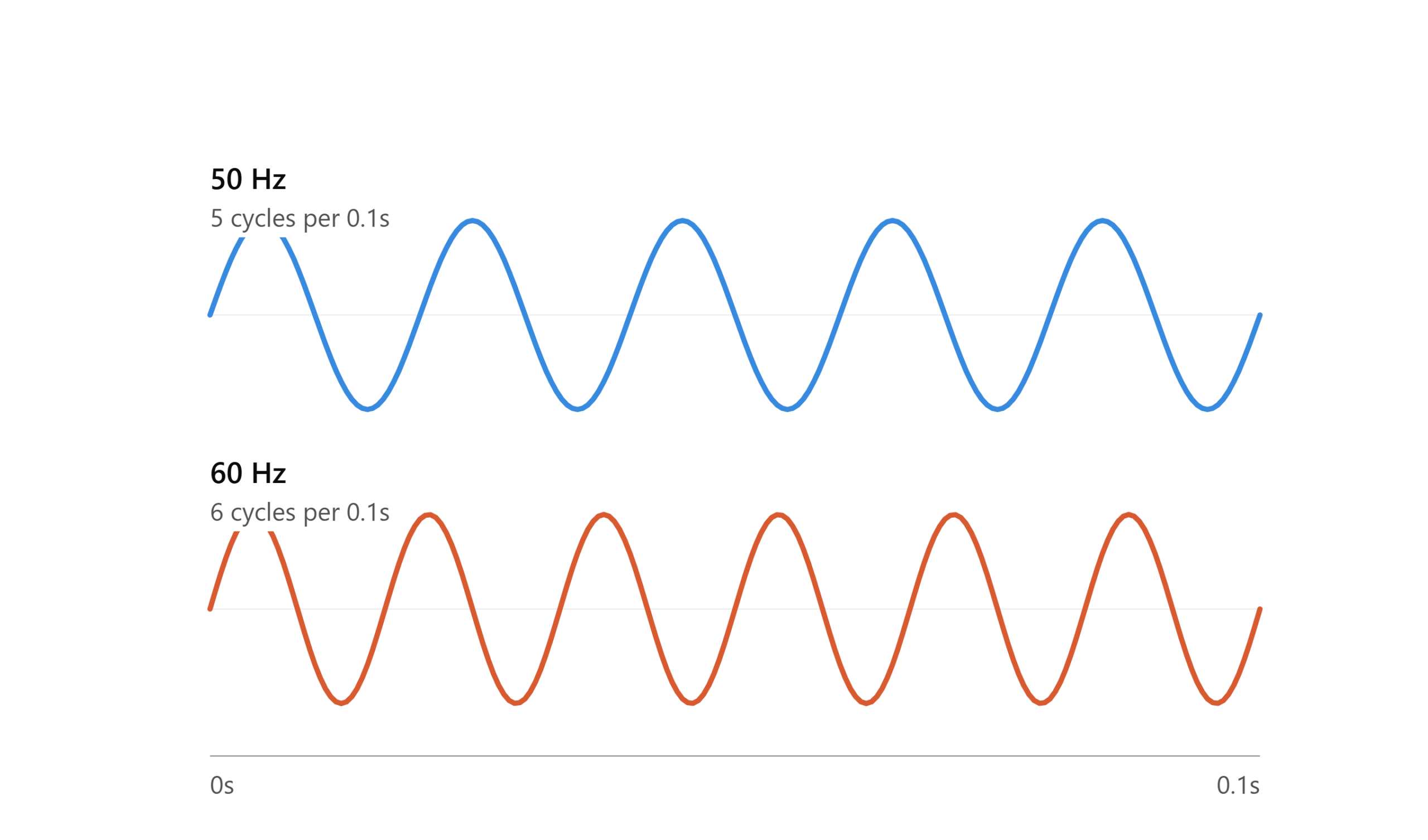
The two most common frequencies are 50Hz and 60Hz, and the main difference between them comes down to region.
- 50Hz is common in most countries across Africa, Asia, and beyond
- 60Hz is common in North America and some South American countries
Generator frequency determines how many times per second the voltage changes direction. For example, a 60Hz generator produces 60 complete voltage cycles every second.
Frequency affects how well a generator matches the equipment it powers. So the frequency of your generator needs to match your equipment.
The Difference Between 50Hz and 60Hz
Difference in Rotational Speed
Generator frequency is directly related to rotational speed, and the relationship can be expressed with the following formula:
Frequency (f) = (RPM × Number of Poles) / 120
RPM is the number of revolutions the generator makes per minute, and the number of poles refers to the number of magnetic poles inside the generator.
As a simple example, if a genset runs at 1,500 RPM with four poles, its frequency is 50Hz; if it runs at 1,800 RPM with four poles, its frequency is 60Hz.
Looking at it the other way, if a genset has only two poles, it would need to reach a striking 3,000 RPM to produce 50Hz.
As engine speed rises, frequency rises; as engine speed falls, frequency falls.
Power Frequency by Region: 50Hz vs 60Hz
In North America, the standard power frequency in the United States and Canada is 60Hz. If you want to use a generator in these regions, you need to match the required standard frequency, so a 60Hz genset is the better choice.
In most of Europe, Africa, and Asia, the standard power frequency is 50Hz. If you’re using a generator in these regions, you should choose a 50Hz genset to comply with local power standards.
We’ve put together a table of standard generator frequencies by region for your reference:
| Region | Frequency | Representative Countries |
| Africa | 50Hz | South Africa, Nigeria, Ghana, etc. |
| Asia | Mostly 50Hz | China, Malaysia, Indonesia, India, etc. |
| Europe | 50Hz | UK, France, Italy, Spain |
| North America | 60Hz | USA, Canada, Mexico |
| South America | Mostly 60Hz | Brazil, etc. |
| Oceania | 50Hz | Australia, New Zealand |
| South Korea | 60Hz | South Korea |
| Japan | 50Hz/60Hz | Kanto/Kansai |
As you can see, generator frequency standards are not uniform worldwide, so you’ll want to understand these regional differences when choosing a generator.
The Need for Frequency Flexibility
Your different projects may call for different frequencies. A dual-frequency genset adapts well to a variety of projects, letting you switch flexibly between 50Hz and 60Hz to meet different power needs.
If you need to move between projects with different frequency standards, we recommend a dual-frequency genset, which reduces your need for separate single-frequency units (50Hz and 60Hz). In Japan, for example, Kansai and Kanto use different generator frequencies, so a dual-frequency generator lets you flexibly meet the frequency requirements of both regions.
Output Voltage
A genset’s frequency and output voltage are related, but it’s not as simple as “higher frequency means higher voltage.” In the full power-generation process, the engine does the work that drives the AC alternator: frequency depends on engine speed and the alternator’s number of poles, while voltage is regulated by the excitation system and the AVR.
But, A generator can be designed as
- 50Hz / 400V
- 50Hz / 415V
- 60Hz / 440V
- 60Hz / 480V
It cannot be assumed that 50Hz necessarily corresponds to a certain voltage, and 60Hz also does not necessarily correspond to a certain voltage.
Different countries and regions have different voltage standards.
| Country/Region | Common Voltage |
| China | 220/380v |
| Most European Countries | 230/400v |
| Some Parts of Southeast Asia | 230/400v |
| United States | 120/208v, 277/480v |
| Canada | 120/208v, 347/600v |
Therefore, when choosing a generator, not only should you confirm whether it operates at 50Hz or 60Hz, but you must also verify the rated voltage, the number of phases, and the connection method.
Why Generator Frequency Matters for Your Equipment
The correct frequency ensures stable power delivery to your equipment. An unstable output current can damage sensitive equipment, such as computers and motors.
If the frequency is too high, it can overheat and damage your equipment, and fuel consumption will also rise. If the frequency is too low, your equipment’s efficiency drops and wear on the genset’s components increases.
Final Thoughts
Understanding and managing your generator frequency is essential for a stable power supply and for protecting your equipment. Choose the right frequency to keep your operations running smoothly. Need a 50Hz/60Hz genset? We offer one-stop power solutions — contact us for more information.
FAQ
Why is my generator frequency below the standard (below 50Hz/60Hz)?
This could be due to equipment overload, problems with the governing system, or fuel and mechanical quality issues.
Why is my generator frequency above the standard (above 50Hz/60Hz)?
This could be caused by a faulty governor or by a sudden drop in load, which causes the frequency to spike.
Why does my generator frequency keep fluctuating?
Unstable fuel supply, AVR faults, and load fluctuations can all cause frequency fluctuations.
How does generator frequency affect fuel consumption?
At 50Hz and 60Hz, different running speeds and output power can lead to different fuel consumption. We recommend comparing fuel consumption (L/h) at different frequencies under the same load.
How can I avoid frequency abnormalities?
You’ll need to maintain your genset regularly — inspecting the engine’s governor, turbocharger, filters, and so on — use high-quality fuel, and avoid changing the load too frequently.
Does generator frequency affect output power?
Rated kW/kVA can differ between 50Hz and 60Hz depending on the engine and generator configuration.Be sure to check the output power rating at 50Hz versus 60Hz.