Single-phase or three-phase? Choosing the right generator set is especially important for your business. Understanding the difference between the two can prevent overload and energy waste, and ensure that your operations run stably.
Single-phase and three-phase generators each have their own characteristics. Next, I will introduce them to you, so that you can better choose the right generator set.
What Is a Three-Phase Generator?
A three-phase generator is a generator that can produce alternating current across three different phases, typically supplying 380V and 440V. Because of its high power and stable voltage, it can accommodate larger loads, and its energy efficiency and reliability are also assured. It is generally used for high-load equipment, such as industrial equipment and heavy agricultural equipment. A three-phase generator is more complex than a single-phase generator; however, in terms of operation and scalability, a three-phase generator is essential where power demand is huge and continuous. It usually takes the form of industrial generators and commercial generators.
What Is a Single-Phase Generator?
A single-phase generator uses one phase of alternating current to generate electricity, and is essentially an independent unit of a three-phase generator. It typically supplies 190V and 220V, and is generally used to power small appliances. When the total load of the connected equipment exceeds the rated power of a single-phase generator, its power generation output drops and becomes unstable, making it unsuitable for large industrial applications; it is more commonly found in places without heavy power needs. It usually takes the form of home generators.
Key Differences Between Single-Phase and Three-Phase Generators
Choosing the wrong generator configuration may lead to increased operating costs, reduced efficiency, equipment compatibility issues, and unnecessary maintenance expenses. Before making an investment, it is necessary to understand the differences in performance, application scope, and long-term value between single-phase and three-phase generators.
Next, I will present the characteristics of the two types of generators.
Application
If you have a large-scale power demand, a three-phase generator might be a suitable choice for you. For large venues such as hospitals, large commercial buildings, and data centers, a three-phase generator is the optimal option.
If your requirements are relatively small, and you only need a generator for residential use, a small office, or as a backup power supply for your home, then a single-phase generator would be suitable for you.
Output
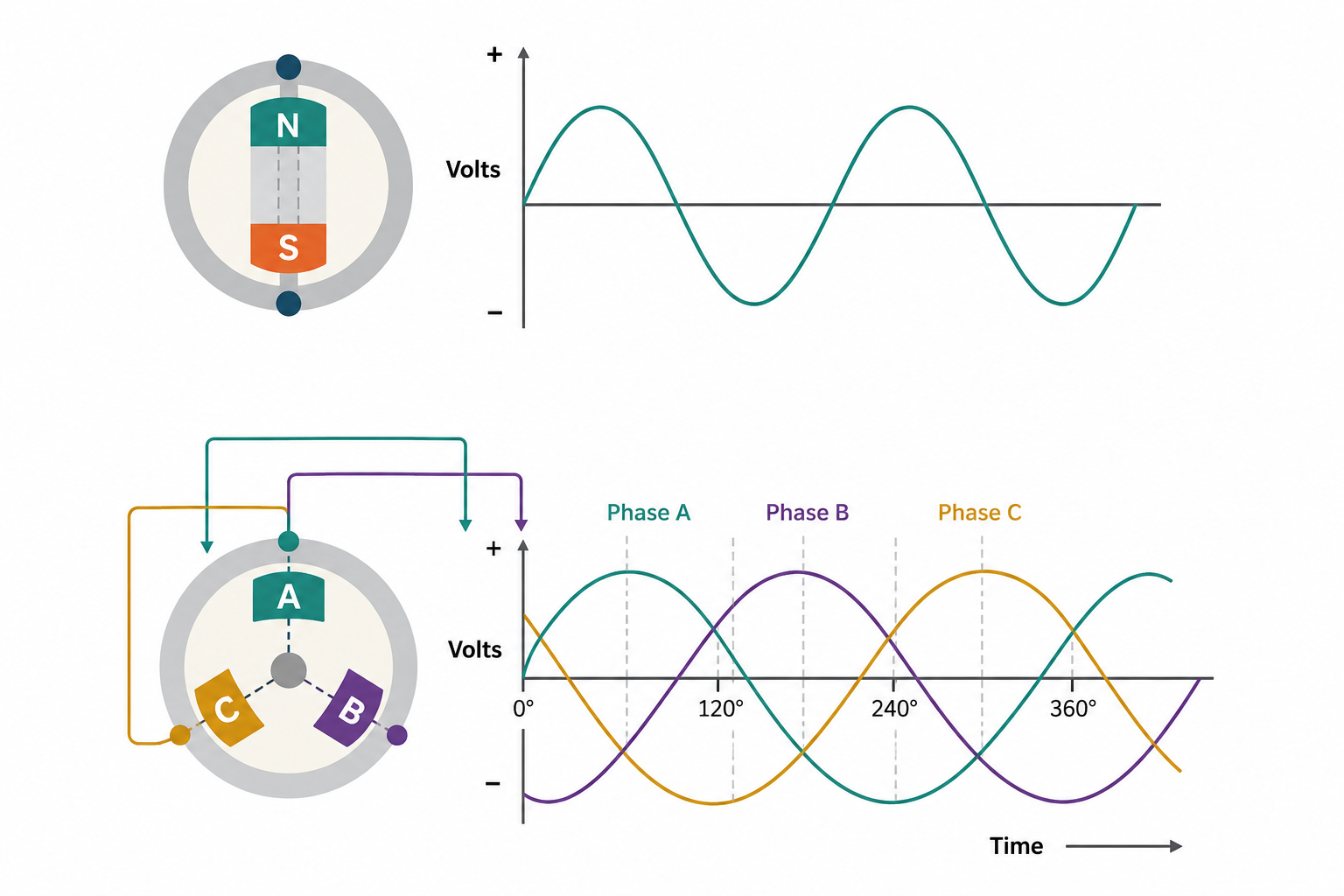
A single-phase generator is equipped with one or two wires and a neutral wire, generating a single sine wave; a three-phase generator is equipped with three wires and a neutral wire, generating three alternating currents with a phase difference of 120 degrees, thus providing continuous power supply, capable of handling larger loads and ensuring the smooth operation of equipment.
Power
Single-phase generator: typically operates around 230V and supports smaller loads, generally ranging from a few kVA up to about 20–30kVA.
Three-phase generator: delivers significantly higher output, commonly in the 380V–440V range, with capacity scaling from tens of kVA up to several thousand kVA.
Cost
The purchase cost of a single-phase generator is relatively low, but the maintenance cost in the long term is relatively high; The purchase cost of three-phase generators is relatively high, but the maintenance cost in the long run is relatively low.
Efficiency
Single-phase generators usually have uneven power output, higher energy loss, voltage fluctuations, and limited load capacity.A three-phase generator has a stronger ability to withstand loads and the voltage is more stable.
Portability
Single-phase generator: Thanks to its simpler internal structure and smaller fuel tank, a single-phase generator is generally more compact and lightweight This makes it easier for you to transport, relocate, and install.
Three-phase generator: Because of its more complex internal structure and larger fuel tank to match its higher output, a three-phase generator is usually heavier and bulkier
Performance
The performance of single-phase generators is relatively poor, with unstable voltage, limited load capacity, and uneven output capacity,but Three-phase generators have superior performance compared to single-phase generators. They offer more stable power output, a more stable voltage, and greater load-bearing capacity.
| Single-Phase Generator | Three-Phase Generator | |
| Application | Generally used for small-scale applications. | Generally used for large-scale facilities. |
| Output | Outputs power as a single sine wave. | Outputs power as three sine waves. |
| Power | Lower power compared to a three-phase generator. | Higher power compared to a single-phase generator. |
| Cost | Low upfront cost, higher cost later on. | Higher upfront cost, lower cost later on. |
| Efficiency | More prone to interruptions and Higher energy loss | More stable and better suited to high-intensity work,Low energy loss. |
| Portability | Generally smaller in size and lighter in weight, making it easier to transport and install. | Usually heavier and larger in size than single-phase generators. |
| Performance | Voltage fluctuation and Low load capacity | It has a stronger ability to withstand loads and the voltage is more stable |
How to choose between single-phase and three-phase
When your electricity consumption is relatively small
If your application mainly involves lighting, office equipment, or small commercial loads, a single-phase generator is often the most economical solution.
When your electricity consumption is on a large scale
If your business operates industrial machinery, pumps, compressors, HVAC systems, or production equipment, a three-phase generator will provide better efficiency, higher reliability, and improved long-term operating performance.
Final Thought
Single-phase and three-phase generators serve different purposes, and which type you choose depends on your power needs. Three-phase generators are better suited for industrial use, construction sites, and high-energy-consuming equipment. Usuperpower will help provide you with the right power solution — if you have any questions, please contact us.
FAQ
Can a single-phase generator be converted into a three-phase generator?
Yes, a single-phase generator can be converted to three-phase using a rotary phase converter (RPC) or a variable-frequency drive (VFD). However, it is actually more advisable for you to purchase a three-phase generator instead, since a three-phase generator can also supply single-phase power, and the total cost is much lower than converting one.
What factors should you consider when choosing a generator?
You need to consider how easily fuel can be obtained, the total load of your equipment, the starting system, noise levels, and other factors.
How do you check the phase sequence of a generator?
You can use a phase sequence tester or phase rotation meter. These devices detect the order of the voltage waveform and indicate whether the system is rotating in the correct direction.
Are three-phase generators more expensive?
Yes, three-phase generators are generally more expensive, because their construction is more complex than that of single-phase generators, their power output is smoother, and their performance is stronger than single-phase generators, so they cost more.
Is a three-phase generator always better than a single-phase generator?
Not necessarily — it depends on your specific needs. If you have large-scale power demands, a three-phase generator is definitely better than a single-phase generator. If you only need power on a small scale, a single-phase generator is just right for you.
Why choosing high-quality equipment is important
Cheap and low-quality generators usually have unstable voltage, are prone to overheating, and consume more fuel. Moreover, such equipment may also pose risks to electrical appliances and power systems.
Therefore, before purchasing a generator, you should not only consider the price, but also take into account the following factors:
Manufacturer reputation, warranty coverage, service support, component quality, compliance with technical specifications, relevant product certifications. A reliable generator is an investment in stable and safe power supply.