Are you ready to face the unexpected power outages? It will lead to production downtime, data loss, project delays, and even more. After reading this article, you will learn about the common types of generators and how to choose the right one for your project.
Different Types of Generators
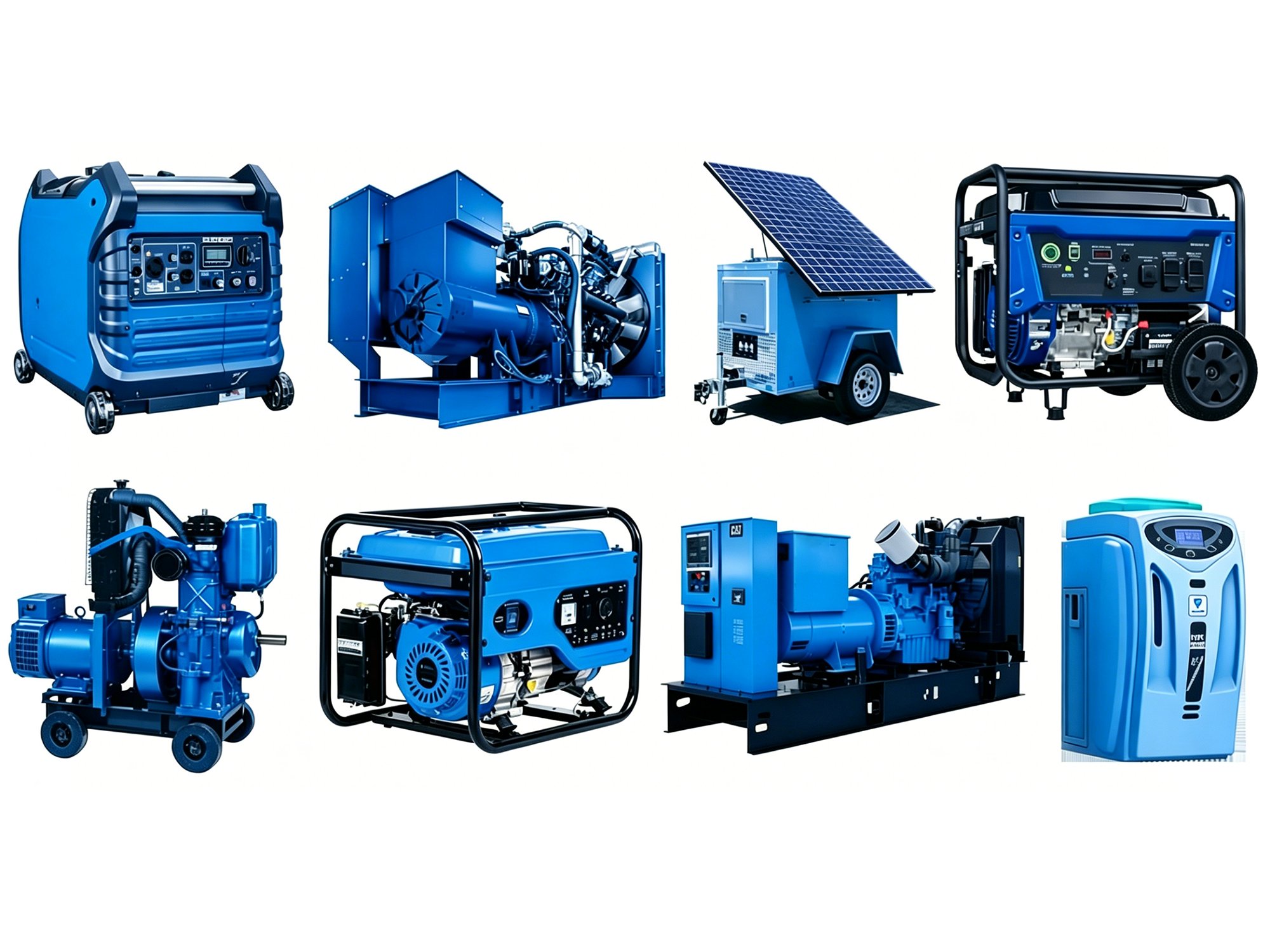
Different generators have their best application field. According to the fuel type and specific application, generators can be classified into 11 main types. The right generator type for your project finally depends on your specific requirements and application.
Diesel Generator
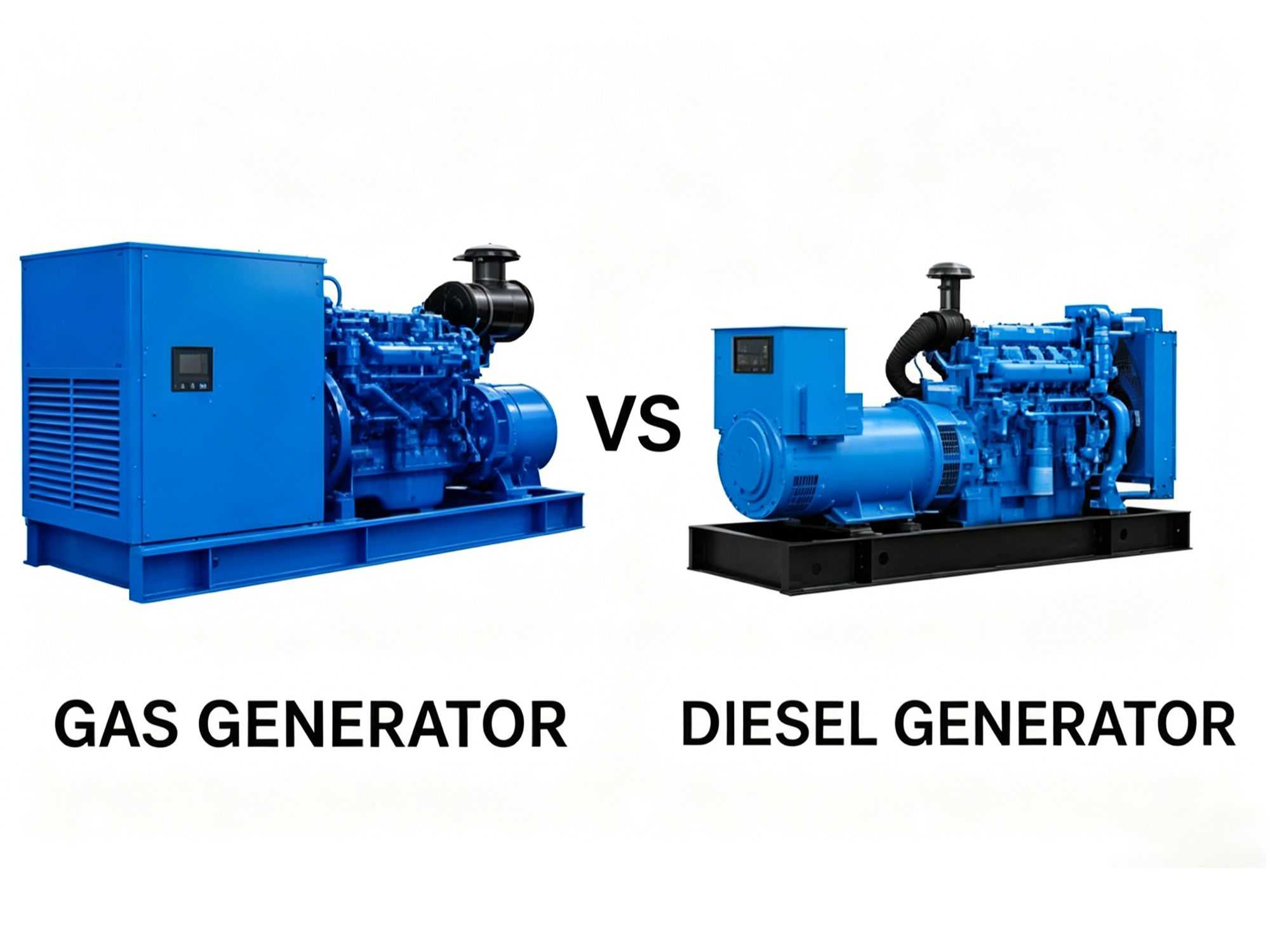
A diesel generator runs on diesel fuel; most of them are used as prime or standby generators. For long-term use, choosing a diesel generator is more cost-effective due to its fuel economy compared to gasoline or gas generators. So if you need a stable power supply for large-scale projects such as hospitals or data centers, diesel generators can suit your needs and reduce your fuel costs.
Gas Generator
The gas generator is your cleaner and safer electric supply choice for projects that require low emissions and a longer lifespan. However, gas generators need to be connected to a natural gas pipeline, which means higher installation and maintenance costs, so they can only operate in areas where the natural gas supply is adequate.
Gasoline Generator
Gasoline generators are usually smaller than diesel generators, and they are widely used in residential and commercial applications. Diesel is usually cheaper than gasoline, so the cumulative cost of replacing fuel each year may be higher. If you need a generator for home standby use, powering small electrical appliances, or projects with a short timeline, a gasoline generator is a good choice.
Propane Generator
The propane can be stored longer than diesel or gasoline, and releases lower emissions. But remember that propane generators generally consume more fuel than diesel generators when producing the same power output, so the cost is higher. Besides, propane needs to be stored under pressure, which may pose a safety hazard.
Solar Generator
A solar generator relies on the sunlight to produce electricity; it’s a zero-emission and renewable choice for your environment. You don’t need to pay for the future fuel costs. But if the solar generator encounters bad weather or doesn’t have sufficient power reserves at night, it can’t provide you with stable electricity. So it is suitable for camping, RV, light residential, and off-grid small devices.
Hydrogen Generator
As a representative of clean power generation, hydrogen generators offer high energy density and produce only water vapor as a byproduct. Currently, there are few hydrogen generators available on the market, but due to their high durability and efficiency, hydrogen generators are an ideal choice for homes, businesses, laboratories, factories, or farms.
Standby Generator
The standby generator is a permanently installed fixed generator, usually equipped with an ATS to automatically switch power during power outages. The standby generator is large in size and requires frequent maintenance. Therefore, it is usually used to provide emergency power for important equipment such as refrigeration rooms, backup lighting, and life support devices, or areas with an unstable power supply.
Portable Generator
The portable generator is of a small size and can be carried by a single person. It can be used for emergency power supply in households, RV power supply, or outdoor camping. It is available with diesel, gas, gasoline, and some custom models also support dual-fuel operation.
Inverter Generator
Inverter generators convert direct current (DC) into alternating current (AC), ensuring that the generator can supply power to precision equipment. Due to their low harmonic distortion and stable output, they are ideal for your sensitive electronics such as laptops, medical devices, communication equipment, and mobile charging systems.
Industrial Generator
Industrial generators are engineered for the demanding industrial requirements; they usually require transportation by crane or forklift and can withstand high-temperature, dusty, and humid conditions. Because industry requires uninterrupted electricity, industrial generators play a critical role in preventing your production downtime, equipment damage, and financial losses during power outages.
Marine Generator
The marine generator provides reliable onboard electricity for navigation systems, lighting, communication equipment, air conditioning, pumps, and other essential electrical loads.
Compared with standard generators, they have stronger corrosion resistance, compact structures, and enhanced safety protection for maritime applications.
Difference Between Each Generator

How to Choose The Right Generator for Your Project?
If you choose an undersized generator, it can lead to overload, unstable voltage, equipment damage, and costly downtime. Before selecting a generator, please follow the steps below:
1.Calculate Your Power Needs
The first step you need to do is to calculate the total power load your equipment needs. For example, a manufacturing factory needs a generator to power heavy equipment, production lines, cooling systems, and necessary office operations:

So the total running load you need for your generator is:
160 + 90 + 120 + 80 + 25 + 20 = 495 kW
During startup, the above loads can temporarily draw 2–6 times their normal running power, depending on the motor type and starting method. Therefore, generator sizing should consider both continuous operating load and peak starting demand to ensure stable voltage and frequency performance.
For this example, the factory may experience a temporary peak demand of 650–800 kW when generators start. In such cases, engineers typically evaluate the largest starting requirements and apply appropriate load sequencing before selecting the generator capacity.
To ensure reliable long-term performance and future production expansion capacity, engineers commonly add a 20% safety margin:
700 kW × 1.2 = 840 kW
Therefore, the recommended generator for you would typically be: One 850 kW industrial diesel generator or multiple parallel generators for load sharing and redundancy
Generator selection is not only about total power capacity. Factors such as fuel efficiency, runtime, automatic transfer switch (ATS), synchronization capability, and maintenance accessibility are also critical for ensuring your uninterrupted production and minimizing operational losses.
2.Select the Appropriate Fuel Type
Fuel choice will affect your operating cost, efficiency, maintenance requirements, and emissions. For most commercial and industrial projects, diesel fuel remains the most cost-effective and reliable option.
3. Consider Your Runtime Requirements
After considering the above factors, You should take the following issues into consideration:
Will the generator serve as the prime power or emergency backup?
How many operating hours are expected each day or annually?
Will the load be constant or variable?
Does my application require an uninterrupted power supply?
How frequently will power outages occur in my area?
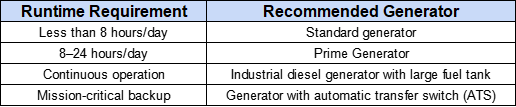
The generator should be selected based on the above questions. Applications with occasional power outages may only require standby backup, while projects with extended or frequent power demand should specify a prime generator. For mission-critical facilities, you need an automatic transfer switch (ATS) for your generator to ensure seamless load transfer during power outages.
Common Generator Sizing Mistakes
If you choose a generator based only on running load, this is the most common mistake. Motor starting current, production expansion, ambient temperature, altitude, and load fluctuations can all affect generator sizing. An undersized generator may result in voltage drops, equipment damage, and unexpected shutdowns.
How can Usuper Power Help?
With so many generator types available, selecting the right solution may be challenging for you. At Usuper Power, we help businesses worldwide identify the most cost-effective and reliable generator solution for their specific projects.
Contact us for a free consultation and customized generator recommendation.
FAQ
What type of oil does a generator use?
SAE 15W-40 is the most common choice for industrial diesel generators. Portable gasoline generators typically use SAE 10W-30, while generators operating in cold climates may require 5W-30 or synthetic oils.
What type of gas do generators use?
Gas generators typically use natural gas or propane (LPG) as fuel. Natural gas generators are commonly installed as standby power systems for homes, commercial buildings, and industrial facilities because they can connect to a natural gas pipeline. Propane generators store fuel in tanks and are often used in remote areas where natural gas pipelines are unavailable.
Which generator is better, AC or DC?
For most applications, AC generators are a better option than DC generators because they are more efficient, easier to transmit power over long distances, and compatible with standard electrical systems.
What is a stage 5 generator?
A Stage 5 generator is a generator that meets the EU Stage V emissions standard for non-road mobile machinery (NRMM). It produces significantly lower emissions than older Stage IIIA or Stage IV generators and is commonly required for construction sites and industrial projects in Europe.
Can generators be synchronized for higher power output?
Yes. Generators can be synchronized and operated in parallel for higher total power capacity. This is commonly used in large industrial, commercial, and critical power applications where a single generator cannot meet the required load demand.
What is an ATS, and do I need one?
If power outages can cause significant downtime, safety risks, or business losses for you, we recommend that you use an ATS because it can automatically transfer the load from the electric supply to a generator when a power outage occurs, and switch it back when the electric supply is restored. For occasional or non-critical use, a manual transfer switch may be sufficient.
What is the difference between standby and prime generators?
A standby generator provides emergency backup power during power outages, while a prime generator is designed to supply power as the main electricity for extended periods. The right choice depends on how often and how long the generator is expected to operate.